Posts

Multi-hypothesis bread

I've had a string of failures with my bread recently. They just don't rise much, most of the time - once or twice they rose nicely, but most of the time they're kinda flat. Not inedibly flat, mind you, but flat enough that they aren't very enticing, not that great for things like french toast, let alone bread pudding. I have a number of hypotheses of why this could be, but rather than trying them meticulously one at a time and keep making uninspiring bread, I decided to throw them all in at once, check that I got something that works, then go from there. So I took my standard bread recipe (except I see now I've been using 3 eggs most of the time where this post said 2, as did my older 1:1 bread post ) and made the following changes: In case the yeast has too little starch to feast on: Drop the flax seed flour (which has a rather strong taste also) and increase regular flours instead. In case the walnuts contain something inhibiting the yeast: Drop the walnuts...
A cross we must all bear

The Kreuzpflicht  has now become the law of my adopted home state, requiring crosses to be on display in all public buildings. As an avowed atheist (there's enough trouble in the world already without having to come up with supernatural trouble) and constitutionalist, this troubles me greatly. But what can one do? It's the law, right? Here are some ways you can stay within the law and help avoid enforced religion. As a private person, your options are limited: - Take the cross off its hook and leave it on a table. Or under a table. Under a chair. In a remote corner. As long as you don't take it with you, it's not theft. - Bring an extra hook and mount it on the bottom of the cross . - Hang other religious symbols near the cross. Sticky-tack is nice for quick mounting. As someone in charge of a public building, the possibilities are nigh endless: - Hang the cross in the company of other religious symbols. For agnostics, add a question mark, for atheists th...

A burger bun experiment

Image
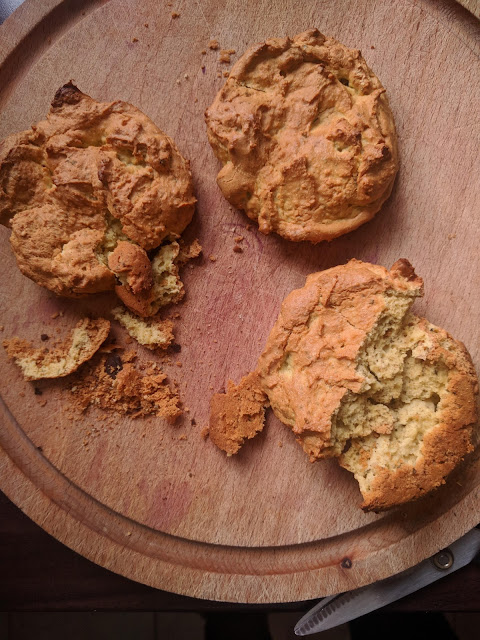
Furthering my inquiries into high-protein baking, I tried out a recipe for no less than the "Ultimate" keto burger buns . Based on my previous experience, I didn't have high hopes for it turning it as ultimate as indicated. Sure enough, what the recipe calls a "batter" that can be poured into the forms turned into a sticky dough that had to be scraped out with a spatula and sat stiffly in the forms. After 18 minutes of baking, as suggested, they were nicely browned, but didn't rise much, and were tough and crumbly: This recipe, however, has a link to the (an) almond flour, and in one of the pictures the nutrition info was visible (not explicitly listed, alas), and it listed about 50% fat, where my almond flour comes with 10%, having being partly de-oiled. So I figured - maybe adding back some fat would help? Thus experiment #1: To a half recipe I added 50 g of canola oil. I also instead of the staff blender used the exceedingly handy beater whisk from...

Bullet journal notation differences (still no pastels)

Image
Oddly, I've been doing bullet journaling for 15 months and only now got around to watching the original video that introduced the concept in August 2013 (I was several years behind this particular trend). I no longer remember which page I took my original style from, possibly this updated version , but there are some differences: The original bullet journal (OBJ) uses boxes for tasks and dots for notes, whereas I've followed the updated version (UBJ) with dots for tasks and dashes for notes. Originally, done tasks were marked with a checkmark in the box, the updated version uses an 'x', I turn the dot into a checkmark - checkmarks look more "done" than 'x'es. The "migration" marks work differently in both OBJ and UBJ: A forward angle means it's moved from a day to the next month , while a backward angle means it's moved to the long-term list. Since I have four, count them, four, levels of lists (daily, "soon" (roughly w...

For a better baking experience: Prepare and repair

Image
I just made the Low-Carb Carrot Cake from ditchthecarbs.com. I used Xylitol as sweetener, added another tsp of vanilla (because that's almost always a good idea), and used a heaping tablespoon of "Mickey's Five-spice" instead of the other spices. The batter was quite satisfying and not very sweet, but the cream cheese frosting part of the recipe is all manner of wrong. The carb/protein ratio is really good, we could use 50/50 whole-wheat and almond flour and still be balanced. Let's see the results: It set fine, but was somewhat dense and dry, falling apart too easily. It was not very sweet at all, possibly due to using a sweetener with a different amount of sweetening power But what I really want to write about is the process, and how this was the most stress-free baking experience ever. I think of it as "prepare and repair". The "prepare" part is also beautifully known as " mise en place " ([mi zɑ̃ ˈplas]) and basically mean...

A comparison of specialty flours

Image
With my last flour experiment, I found a reasonable proportion of gluten to flour for making simple baking experiments: 25g gluten to 100g water gives something that's roughly bread-like in texture, if somewhat wet. But what happens when you use not just gluten, but also other flours? How do the various flours compare in terms of water absorption and baking effect? Let's find out! Since I'd be adding other flours that have their own properties, I reduced the amount of gluten to 10g, and used 25g of each of the other flours. I still went with 100g of water, but this time I used a finer scale to make sure my measurements were much more precise. I also added 1g (a "dash") of salt, to make it potentially edible. I did three batches, because I only have four of the little baking pans, and because I don't want too much delay between the first and last concoction. This was my procedure: Measure out the gluten, flour, and salt in each baking pan in advance. ...

Bread without flour

Image
They said it couldn't be done! They called me mad! But I SHOWED THEM! Muahahaha! Yes, this is indeed a bread made without flour. Well, without wheat flour. Actually, without the carbohydrate parts of the wheat flour. It uses gluten and seed flours instead, but it comes out nice and springy, slightly denser than I would normally get it, but delicious. I ended up using less flour than usual for this, since my flour tests (post coming up on them as soon as I get the third part done) show that both sunflour and flaxseed flour soak up more water than regular flour. And indeed, with 4/5 the usual amount the dough was at the same time tough and sticky. Next time I'll lower the amount of flour a bit and see if that improves the oven spring by virtue of leaving more water available to boil and expand. Ingredients: 100g gluten, 150g flaxseed flour, 250g sunflower seed flour, 1/2 tsp baker's malt (Backmalz), 2 tsp salt. Mixed these together, but ended up putting 100g of the...