Posts

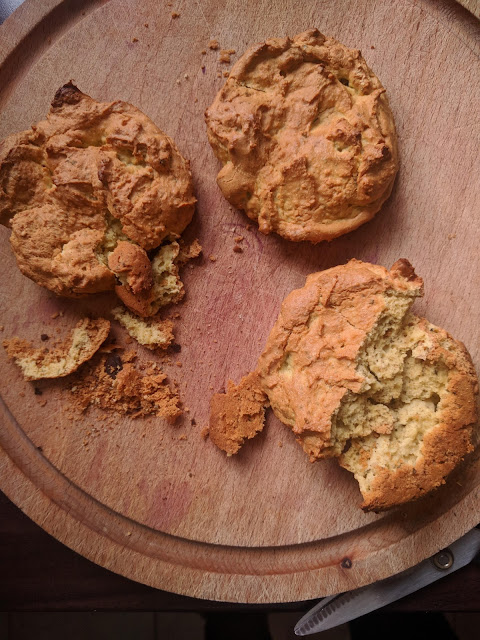
A burger bun experiment
Image
Furthering my inquiries into high-protein baking, I tried out a recipe for no less than the "Ultimate" keto burger buns . Based on my previous experience, I didn't have high hopes for it turning it as ultimate as indicated. Sure enough, what the recipe calls a "batter" that can be poured into the forms turned into a sticky dough that had to be scraped out with a spatula and sat stiffly in the forms. After 18 minutes of baking, as suggested, they were nicely browned, but didn't rise much, and were tough and crumbly: This recipe, however, has a link to the (an) almond flour, and in one of the pictures the nutrition info was visible (not explicitly listed, alas), and it listed about 50% fat, where my almond flour comes with 10%, having being partly de-oiled. So I figured - maybe adding back some fat would help? Thus experiment #1: To a half recipe I added 50 g of canola oil. I also instead of the staff blender used the exceedingly handy beater whisk from...

Bullet journal notation differences (still no pastels)

Image
Oddly, I've been doing bullet journaling for 15 months and only now got around to watching the original video that introduced the concept in August 2013 (I was several years behind this particular trend). I no longer remember which page I took my original style from, possibly this updated version , but there are some differences: The original bullet journal (OBJ) uses boxes for tasks and dots for notes, whereas I've followed the updated version (UBJ) with dots for tasks and dashes for notes. Originally, done tasks were marked with a checkmark in the box, the updated version uses an 'x', I turn the dot into a checkmark - checkmarks look more "done" than 'x'es. The "migration" marks work differently in both OBJ and UBJ: A forward angle means it's moved from a day to the next month , while a backward angle means it's moved to the long-term list. Since I have four, count them, four, levels of lists (daily, "soon" (roughly w...

For a better baking experience: Prepare and repair

Image
I just made the Low-Carb Carrot Cake from ditchthecarbs.com. I used Xylitol as sweetener, added another tsp of vanilla (because that's almost always a good idea), and used a heaping tablespoon of "Mickey's Five-spice" instead of the other spices. The batter was quite satisfying and not very sweet, but the cream cheese frosting part of the recipe is all manner of wrong. The carb/protein ratio is really good, we could use 50/50 whole-wheat and almond flour and still be balanced. Let's see the results: It set fine, but was somewhat dense and dry, falling apart too easily. It was not very sweet at all, possibly due to using a sweetener with a different amount of sweetening power But what I really want to write about is the process, and how this was the most stress-free baking experience ever. I think of it as "prepare and repair". The "prepare" part is also beautifully known as " mise en place " ([mi zÉ‘̃ ˈplas]) and basically mean...

A comparison of specialty flours

Image
With my last flour experiment, I found a reasonable proportion of gluten to flour for making simple baking experiments: 25g gluten to 100g water gives something that's roughly bread-like in texture, if somewhat wet. But what happens when you use not just gluten, but also other flours? How do the various flours compare in terms of water absorption and baking effect? Let's find out! Since I'd be adding other flours that have their own properties, I reduced the amount of gluten to 10g, and used 25g of each of the other flours. I still went with 100g of water, but this time I used a finer scale to make sure my measurements were much more precise. I also added 1g (a "dash") of salt, to make it potentially edible. I did three batches, because I only have four of the little baking pans, and because I don't want too much delay between the first and last concoction. This was my procedure: Measure out the gluten, flour, and salt in each baking pan in advance. ...

Bread without flour

Image
They said it couldn't be done! They called me mad! But I SHOWED THEM! Muahahaha! Yes, this is indeed a bread made without flour. Well, without wheat flour. Actually, without the carbohydrate parts of the wheat flour. It uses gluten and seed flours instead, but it comes out nice and springy, slightly denser than I would normally get it, but delicious. I ended up using less flour than usual for this, since my flour tests (post coming up on them as soon as I get the third part done) show that both sunflour and flaxseed flour soak up more water than regular flour. And indeed, with 4/5 the usual amount the dough was at the same time tough and sticky. Next time I'll lower the amount of flour a bit and see if that improves the oven spring by virtue of leaving more water available to boil and expand. Ingredients: 100g gluten, 150g flaxseed flour, 250g sunflower seed flour, 1/2 tsp baker's malt (Backmalz), 2 tsp salt. Mixed these together, but ended up putting 100g of the...

Flax and sunflour bread - for great rising!

Image
A simple but successful bread, made with flax flour and sunflour. After doing some testing of various flours (results to be posted later when I've tested the rest of my 12 different flours) and looking through my notes, I came to the conclusion that almond flour, even the fine varieties, is just not good for bread. So I used sunflower seed flour (sunflour) instead of the almond flour, plus I added just a bit (0.5% by weight) of baker's malt, which supposedly helps feed the yeast. The result was just excellent - rose like a charm, and did an oven spring I could palpably watch happening. I also this time put it into a hot oven, rather than as usual heating the oven with the bread in it. I still don't know which gives the better result - it seems to me the slow heating would allow the inner parts to get warmer and expand before the outer parts get too baked and fixed, but maybe that's not an issue, and the loss of gas by slower heating is counterproductive. Another ...

A gluten experiment

Image
It's Saturday, and you know what that means: Baking experiments! Ok, maybe you didn't know, since I haven't posted so much about it, but at least today I did one, testing how gluten behaves in various solutions. Would it poof up in the oven? Would it form durable bubbles? How wet would it get? What would the final consistency be? I decided to keep the tests as simple as possible, using just a liquid and gluten, not even adding salt. I did four tests in little teflon pans: #1: I took 50ml cold water and poured 25g gluten into it, stirring as best I could, then let it stand for half an hour. #2: Seeing how #1 clumped up, I now took 100ml cold water and slowly poured 25g gluten into it while stirring, then let it stand for half an hour. #3: With the oven preheated, I again took 100 ml cold water and slowly poured 25g gluten into it while stirring. #4: Lastly, I beat one egg and slowly poured 10g gluten into it while stirring, then beat it some more. I pour four into t...