Posts

Almond flour isn't just almond flour

Image
Looking around on the internet for how much almond flour to use instead of regular flour, I kept finding big variations, from 1:1 replacement to 1:2. Since baking is fairly finicky with the amount of ingredients, this confused me. But when I grabbed an extra bag of almond flour at the local grocery store (yes, there are specialty flours at the grocery store here), I noticed a difference in consistency and decided to take a closer look. Here's a close-up of the two flours using a macro lens. On the left is MeaVita Mandelmehl, on the right Borchers Premium Mandelmehl. In both cases, I've used a blunt instrument to gently distribute the flour to better see the difference. The flour on the left, the MeaVita brand flour, is in much larger chunks than on the right. The MeaVita flour also feels more moist, though I don't know if that's a direct effect of the size or because more oil has been extracted from the Borchers flour. It is, however, obvious that the two flour...

An excellent high-protein deep-dish pizza dough

Based on Bobby Flay's Chicago deep-dish pizza dough; throwdown recipe , I replaced the 5 1/2 cups of all-purpose flour with 1 cup of seitan base , 1 cup of flax-seed flour, 1 cup of whole-wheat flour, 1 cup of all-purpose flour, and 1 cup that I'm not sure what was now, either more all-purpose flour or more flax-seed flour. Either would work, I'm sure. Notice that this is slightly less flour than the recipe calls for, that was on purpose, as the seitan base can make it rubbery if there's not enough water. The dough came out awesome. It rose like crazy and had a structure to die for. Combined with a spicy tomato sauce, pepperoni pizza, and cheese, this was a balanced pizza that blew us away. Balance: If the last cup was regular flour, it was 3:2 carb:protein. If it was flax-seed flour, it would be 1:1. Yes, you can have your protein pizza and eat it, too.

Bread of the day: Sunflower seed flour and extra water

Image
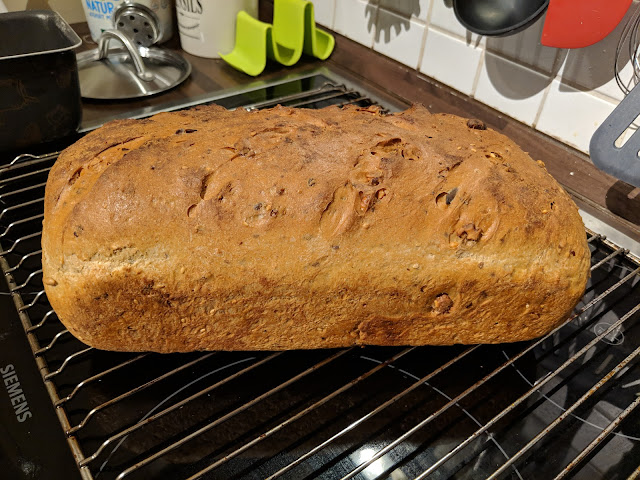
I've been baking more 1:1 breads recently, and I'm have nearly consistent success (unlike the English muffins and pancakes, which came out weird). There is some variations depending on the flour in question, so I am going to do short write-ups of what works and what doesn't. Some things have definitely worked, like this bread, which I think was done with flaxseed flour: Today's bread is also a regular loaf (what Danes would call "franskbrød"). Ingredients: 125 g. seitan base (a.k.a. vital wheat gluten) 100 g. sunflower seed flour (flower flour!) 375 g. flour (about 125 g. of which may or may not have been whole wheat, our boxes were mixed). 2 teaspoons salt 50 g. seed mix 21 g. fresh yeast 375 ml lukewarm water 2 eggs about 50 ml oil The procedure was the same as in  the original bread post . The dough was quite moist, not really coming together in the normal dough lump. It didn't rise nearly as much as the great successes, but somewhat: ...

I made 1:1 bread, and it is de-leeecious!

Image
If you have celiac disease or an actual gluten sensitivity, then this post is not for you. If you avoid gluten solely because of some dieting fad, you're losing out. This is good bread. This is bread that's better for insulin-resistant people. This is... high-gluten bread! Disclaimer: I am neither a nutritionist nor a doctor, I just play around with bread. This is pretty much my standard bread recipe, but substituting part of the flour with pure gluten - available as "seitan base", for instance this one on Amazon . This is somewhat more expensive (the price/g of protein is about the same for flour and seitan base), but it has a 50:50 carb:protein balance. Normal bread is more like 7:1, bad news for anyone with insulin problems. If you want to try this with your own favorite bread recipe, substitute about 1/4th of the flour with the seitan base and another about 1/6th with flax flour. Other proportions will work, too, I'll show you how to calculate it belo...

Bullet Journal Statistics April 2017

Image
Yikes! Another month gone by! But at least my bullet journal is still active and I get stuff done much more than before it. My at-work one isn't doing as well, but still helps me remember little random things that are not on larger plans. April saw nothing worse than 10 days of procrastination. I marked a total of 64 tasks done and 8 cancelled, none migrated. 32 of the tasks got done the same day they were put on - hey, that's exactly half! That's more than I really expected, since many tasks get added later in the day than I can act on them. I think I have a better system for making this chart now, but it's still tricky to get right. As for monthly tasks, I completed 6 straight off the task list, scheduled 3, and the remaining 15 got moved to May. Not a good record. I should get more used to looking at the task list, somehow. The tracking of daily tasks worked so-so. I marked the watering column blue and it got used, but the exercise things did not see much us...

Bullet Journal statistics for March 2017: When Statistics Go Bad

Image
Statistics: You're doing it wrong. Except if you're a professional statistician, in which case any wrong-doing would be expected to at least be intentional. I've been tallying my tasks with a simple chart like this: This is a compressed version of the markings in the diary. For each day, I tally the number of tasks done, migrated, or cancelled, plus the ones that got postponed. I think of it as a "wind diagram". It is a rather nice representation, for it not only pretty but also self-correcting: If any of the +N columns have a number, there must be a number as least that large down and to the left. The difference is the number of tasks of that postponement that got finished that way. It also allows me to correct mismarkings, such as when I miscount the number of dashes in a postponement marker (marked with a *). It's also very simple to make, only requiring looking at one day at a time and counting marks. The "Abs" column is just a summation...

Bullet Journal Statistics for February 2017

Image
Another month has passed, and it's time to look back at how my bullet journal is doing. February was unusual for me being sick for a while, and for +Mickey Blake   going to the US starting on the 9th. Unsettles my daily rhythm, such as it is, and means I have to take care of  +The Frida Diaries  myself. Still, I survived, and got some things done. Let's see how March becomes unusual:) A total of 110 daily tasks were handled, including carry-over from last month, but not including carry-over to next month. Of these, 71 (65%) were done the same day, and 14 (13%) got done the day after. However, this time I postponed tasks for much longer, partly while sick, but also afterwards. One tasks got done after 7 postponement, and one after 8 (required going to the other side of town with Frida in tow)! My arrow system gets annoying enough when I have to write so many dashes that I eventually get it done:) I'm happy to see that the long-postponed tasks don't tend to then get ...